STILFSER
JOCH
Forty-eight hairpins. 2,757 metres. The hardest climb in the Alps.
The preview is updated in real time
Note: Printed posters are made to order for you and are excluded from the right of withdrawal in accordance with Section 312g(2)(1) of the German Civil Code (BGB).
Please enter at least one name or date.
PDF · Instant download after ordering
STILFSER JOCH.
Forty-eight hairpins. One thousand five hundred and eighty metres of altitude gain. A single pass that has become, for many, the very definition of what an Alpine pass is.
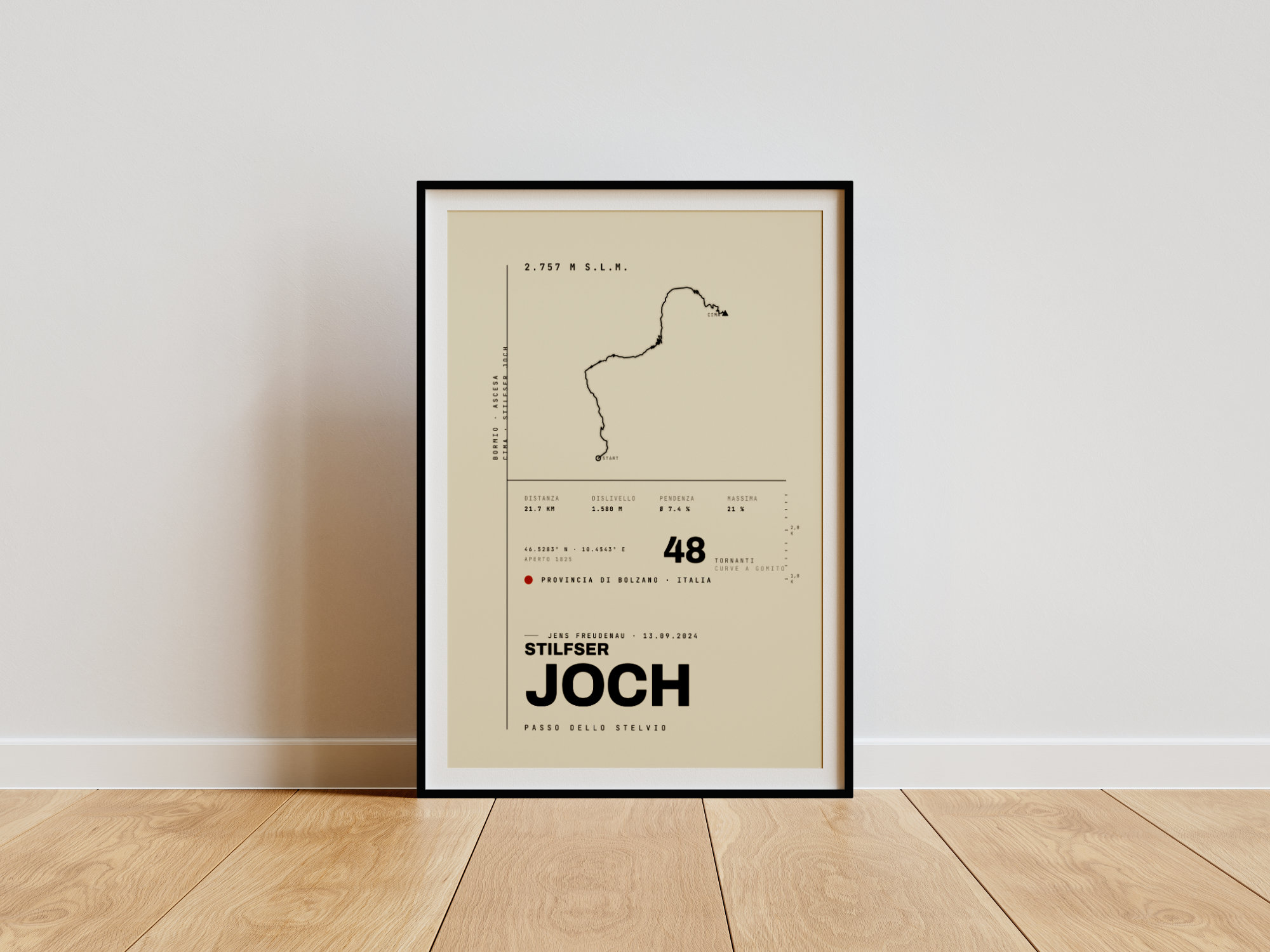
The Passo dello Stelvio – Stilfser Joch in German – stands at 2,757 metres, making it the second-highest paved mountain pass in the Alps. Only the French Col de l'Iseran rises seven metres higher. Yet no other road in the Alps tells its story as unmistakably as the Stelvio: through a sequence of 48 numbered hairpins that fold up the north ramp like a stone staircase into the sky.
The road was built between 1820 and 1825 under the Austrian Emperor Francis I – not for tourism, but as a military supply route connecting Milan with the South Tyrolean Vinschgau valley. The engineer in charge, Carlo Donegani, created one of the most significant works of early-19th-century Alpine engineering: a road whose alignment does not fight the impossible topography but traces it.
For road cyclists, the Stelvio is more than a pass – it is a rite of initiation. From Prad, it is 24.3 kilometres at an average gradient of 7.4 percent. The maximum gradient reaches 21 percent. Those who pass the final hairpin and read the summit sign "Passo dello Stelvio 2757 m" have completed one of the hardest ascents in Europe.
In the Giro d'Italia, the Stelvio has been crowned the "Cima Coppi" – the highest point of the race – on multiple occasions. Fausto Coppi himself was the first to crest the pass in 1953, ahead of his great rival Hugo Koblet. Six decades later, in 2014, Nairo Quintana reportedly attacked beyond the Iceman regulation point in a snowstorm – a stage that remains controversial to this day.
Tour history & Records.
The Stelvio has been crossed 11 times in the Giro d'Italia – more often than any other pass above 2,500 metres. Six times it was the Cima Coppi, the highest point of the entire race. The Tour de France has never included the pass for logistical reasons.
First ascent as Cima Coppi: 1965, by Graziano Battistini. Most celebrated stage: Giro 2017, Stage 16 (Rovetta–Bormio), when Vincenzo Nibali attacked in the Sky-rider Mikel Landa's jersey and took the pink jersey on the Stelvio.
In summer the road is open between June and October. On car-free days (usually late August), the pass transforms into the largest road-cycling festival in Europe.
- Height
- 2.757 M
- Opened
- 1825
- Country
- Italia
What else you need you should know.
The poster shows the north ramp from Prad to the summit: 24.3 km distance, 1,580 metres of altitude, average gradient 7.4%, maximum 21%. The elevation profile is rendered with millimetre precision from official GPS data.
Yes. In personalisation mode you can add your name, the date of your ride and your best time. Personalisation is free of charge.
As a printed poster in DIN formats A1 (59.4 × 84.1 cm), A2, A3 and A4. Printed on 170 g/m² semi-gloss premium paper. Alternatively as a digital PDF download.
Printing and shipping are handled by a local print partner in Europe and usually take 3 to 5 working days within the EU. The digital PDF download is available immediately after completing the order.
The Stelvio is one of the most iconic gifts for road cyclists. For those who are undecided, we also offer gift vouchers that the recipient can redeem for the poster of their choice.
Name, date, personal time, and an optional subtitle. All fields are optional – you can also order the standard poster without personalisation.