
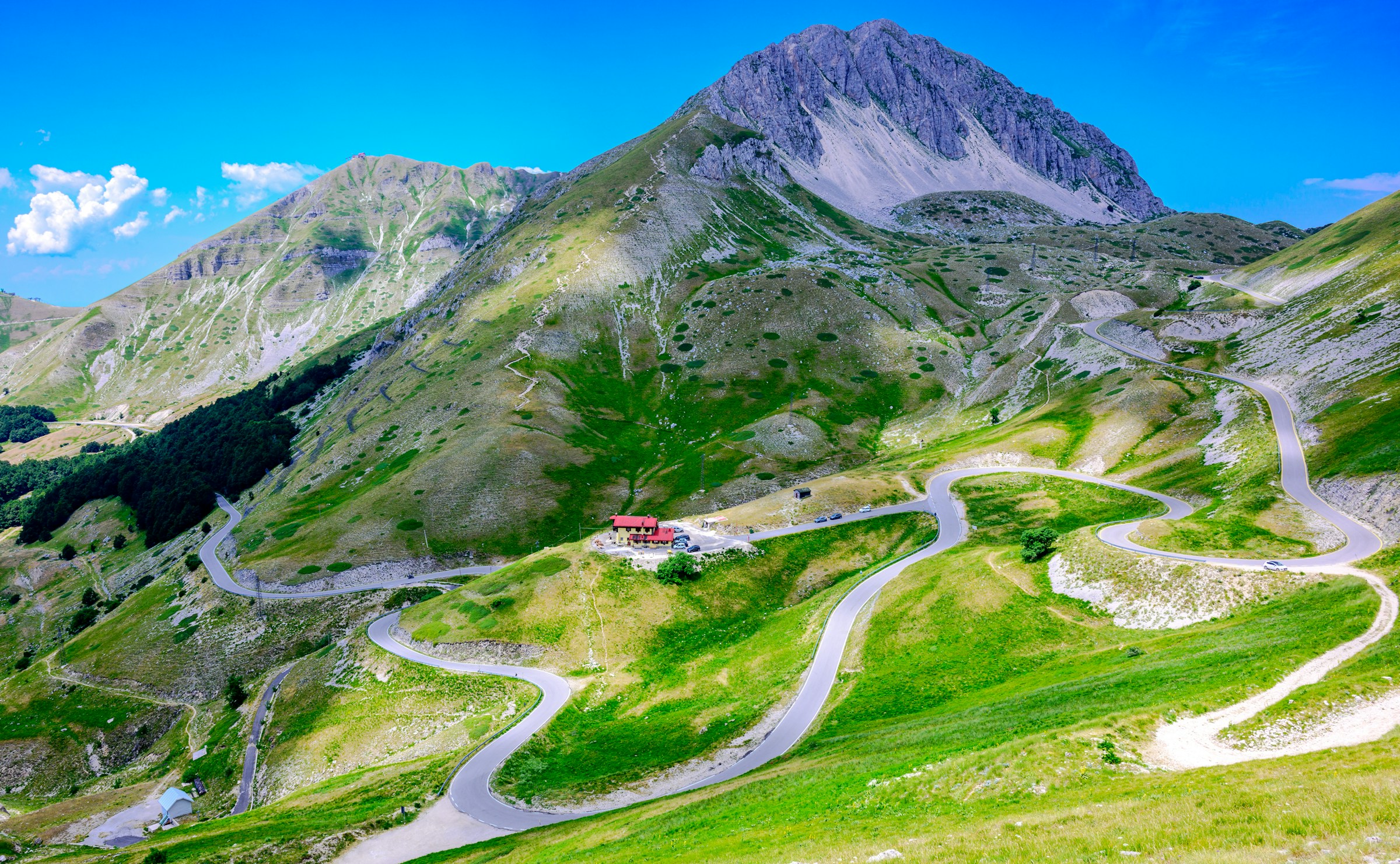
Made it to the top, stopped the clock – and then the question everyone asks: was that good? Alpe d'Huez, Mont Ventoux and the Stelvio attract the wildest numbers. This article puts your time into context: with transparent benchmarks based on power, the pros' records and a few reasons why two times on the same mountain often aren't comparable.
Where the benchmarks come from
On a climb, one number matters most: power per kilogram of body weight (W/kg). A 75 kg rider who can hold 225 watts for an hour rides at 3.0 W/kg. The times in the table are calculated from that power – for a 75 kg rider with 9 kg of bike and kit, no wind, steady pacing and no stops. Lighter riders are marginally faster at the same W/kg, heavier ones marginally slower.
| Power | Level | Alpe d'Huez | Mont Ventoux (Bédoin) | Stelvio (Prato) |
|---|---|---|---|---|
| 2,0 W/kg | leisure rider | 1:53 | 2:44 | 3:04 |
| 2,5 W/kg | beginner with some base | 1:31 | 2:12 | 2:28 |
| 3,0 W/kg | trained amateur | 1:16 | 1:51 | 2:05 |
| 3,5 W/kg | ambitious amateur | 1:06 | 1:36 | 1:48 |
| 4,0 W/kg | very strong, racing level | 0:58 | 1:25 | 1:35 |
| 5,0 W/kg | elite amateur | 0:48 | 1:10 | 1:18 |
Pros ride these climbs at a good 6 to 7 W/kg. As a rule of thumb: anyone who gets up Alpe d'Huez in under an hour is among the strongest in any sportive field.
Alpe d'Huez: the magic hour
13.8 km from Le Bourg-d'Oisans, 8.1% on average and 21 numbered hairpins. The first kilometres are the steepest – go too hard here and you pay for it in the bends above. For amateurs, the hour is the big target; 1:15 to 1:30 is a solid time.
The record fell in 2026: Tadej Pogačar won stage 19 of the Tour de France in 35:26, more than a minute faster than Marco Pantani in 1995 (36:40). Pantani's mark had stood for over 30 years.
Mont Ventoux: not a metre to recover
From Bédoin it's 21.4 km with 1,610 m of climbing at 7.5% – without a single flat section. The forest of Saint-Estève is the steepest part; above Chalet Reynard, wind and heat join in. Under two hours is a good goal, under 1:30 a strong ride.
The fastest recorded ascent from Bédoin came from Tadej Pogačar at the 2025 Tour, in around 54:41. That beat Iban Mayo's 55:51 from the mountain time trial of the 2004 Critérium du Dauphiné.
The Stelvio: altitude costs time
From Prato allo Stelvio it's 24.3 km, 1,808 m of climbing, 7.4% on average and 48 hairpins up to 2,757 m. The table underestimates this climb: above roughly 2,000 m your power drops noticeably in the thinner air – expect 5 to 10% fewer watts in the top third. Under two hours is a very good amateur time. How the three ascents from Prato, Bormio and Santa Maria differ is covered in our Stelvio ascents comparison.
Why times are so hard to compare
- Start and finish: on Alpe d'Huez some time from the edge of town, others from the roundabout; 700 m difference is easily two minutes.
- Wind: on the Ventoux, a headwind over the last 6 km can cost ten minutes.
- Stops: Strava shows moving time and elapsed time – for a fair comparison, use the segment time.
- Form and heat: at midday in July you're slower at the same power than at eight in the morning.
The fairest comparison is the climb's official Strava segment – and the most honest one is with yourself from last year.
Your time on the wall
Whether it's 58 minutes or 2:10 hours: the time is yours. Our pass posters show the route with distance, elevation gain and hairpins – and, if you like, your name, the date of your ascent and your time. They're available for Alpe d'Huez, Mont Ventoux, the Stelvio and six more climbs in the pass series.
Climbed a different mountain? Upload your GPX file and turn it into your own poster.